
solar energy in Iran has been considered one of the renewable energy sources. The two main types of using solar energy are Photovoltaic (PV) Solar Energy and Solar Thermal Energy.
1. Photovoltaic Solar Energy:
Photovoltaic (PV) solar energy converts sunlight into electricity using solar cells. The structure and operation of PV systems are as follows:
Structure of a Solar Cell
1. Semiconductor Layers:
– Solar cells are typically made from semiconductor materials, with silicon being the most common.
– Silicon cells have two types of semiconductors: n-type (with free electrons) and p-type (with electron holes).
– The n and p layers are alternately placed to form a p-n junction.
2. Electrical Contacts:
– Metal layers are placed on the top and bottom surfaces of the cell to collect electrons and transfer the electric current to an external circuit.
3. Anti-Reflective Coating:
– An anti-reflective coating is applied to the cell’s surface to increase the amount of absorbed light and reduce reflection.
Operation of a Solar Cell
1. Sunlight Absorption:
– When sunlight hits the solar cell, the photons transfer their energy to the electrons in the semiconductor layers.
2. Creation of Electron-Hole Pairs:
– The energy from the photons causes the electrons to separate from their holes, creating electron-hole pairs.
3. Separation of Electrons and Holes:
– Due to the electric field in the p-n junction, electrons move towards the n layer and holes move towards the p layer.
4. Generation of Electric Current:
– The movement of electrons to the n layer and holes to the p layer creates an electric current. This current is transferred to the external circuit through the metal contacts and can be used to provide power.
Photovoltaic Systems
1. Photovoltaic Modules:
– Solar cells are connected in series and parallel to form larger modules known as solar panels.
2. Inverter:
– Inverters convert the direct current (DC) produced by the solar cells into alternating current (AC), which is necessary for use in the power grid and household appliances.
3. Batteries and Storage Systems:
– To store the generated energy for use when the sun is not shining, batteries and storage systems are utilized.
4. Structures and Installation:
– Solar panels are installed on structures that position them at an optimal angle to maximize sunlight absorption.
Advantages of Photovoltaic Solar Energy
– Sustainable and Renewable: Utilizes sunlight, an inexhaustible source.
– Reduces Pollution: Does not produce greenhouse gases or air pollution.
– Cost-Effective: With technological advancements and decreasing production costs, solar power is becoming more affordable.
– Energy Independence: Can help reduce reliance on fossil fuel sources.
Photovoltaic energy is one of the most promising renewable energy sources that can play a significant role in providing clean and sustainable energy.

2. Solar Thermal Energy:
Solar Thermal Energy uses the sun’s energy to produce heat, which is then converted into electricity. Solar thermal energy systems typically include various components that work together to complete this process. Below, I explain the structure and operation of these systems:
Structure of Solar Thermal Energy Systems
1. Thermal Collectors:
– Flat Plate Collectors: These collectors include an absorber plate that absorbs sunlight and converts it into heat. They are typically used for producing hot water in small household systems.
– Concentrating Collectors: These collectors use mirrors or lenses to concentrate sunlight onto a specific point. They include several main types:
– Parabolic Trough: These collectors have curved mirrors that focus sunlight onto an absorber tube.
– Solar Power Tower: In this system, mirrors (heliostats) concentrate sunlight onto a central tower with a receiver.
– Stirling Dish: Curved mirrors focus sunlight onto a receiver at the center of the dish.
2. Heat Transfer Fluid:
– This fluid is used in solar thermal systems to absorb and transfer heat. It can be water, thermal oil, or molten salt.
– The heat transfer fluid carries the heat from the thermal collectors to the boiler or heat exchanger.
3. Boiler and Heat Exchanger:
– In the boiler or heat exchanger, the heat transfer fluid transfers its heat to water, producing steam.
– The produced steam is used to drive steam turbines for electricity generation.
4. Turbine and Generator:
– The steam generated by the boiler is directed to the turbine.
– High-pressure steam hitting the turbine causes it to spin, generating electricity through the connected generator.
5. Thermal Storage Systems:
– To store thermal energy for use when the sun is not shining, thermal storage systems are used.
– These systems include tanks that contain heat storage materials like molten salt or phase change materials (PCM).
Operation of Solar Thermal Energy Systems
1. Sunlight Absorption:
– Collectors absorb and concentrate sunlight.
– The concentrated sunlight heats the heat transfer fluid.
2. Heat Transfer:
– The heat transfer fluid carries the absorbed heat to the boiler or heat exchanger.
– The heat is transferred to water, producing steam.
3. Electricity Generation:
– The produced steam is directed to the turbine, causing it to spin.
– The turbine is connected to a generator, which produces electricity.
4. Heat Storage:
– Excess thermal energy is stored in thermal storage systems for use when needed.
Advantages of Solar Thermal Energy
– Sustainable and Renewable: Utilizes sunlight, an inexhaustible source.
– Reduces Pollution: Does not produce greenhouse gases or air pollution.
– High Power Output: Capable of producing high power on a large scale.
– Thermal Storage: Allows for storing thermal energy and using it during non-sunny periods.
Solar thermal energy systems can be an effective and sustainable solution for electricity generation, reducing reliance on fossil fuel sources.
Given Iran’s geographical location and high solar radiation, there is significant potential to develop both types of technologies. Especially in the desert and semi-desert areas of the country, the use of solar energy can be a sustainable and environmentally friendly solution.
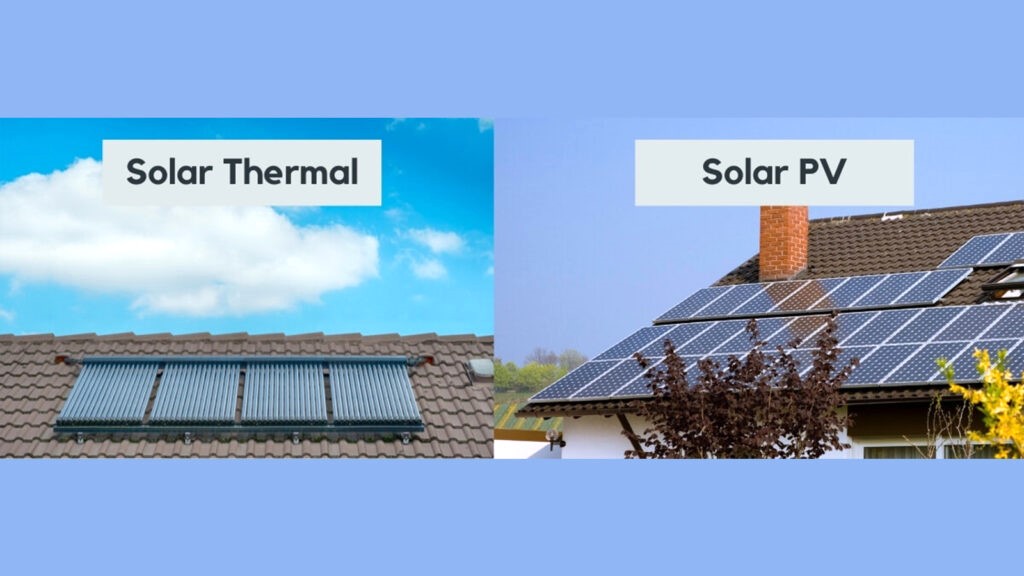
Between solar photovoltaic energy and solar thermal energy, which one has the ability to produce more electricity?
Iran’s ability to generate electricity through photovoltaic solar energy (PV) and concentrated solar power (CSP) depends on various factors, but some advantages and disadvantages of each technology can be considered to reach an appropriate conclusion:
Photovoltaic Solar Energy (PV)
Advantages:
1. Ease of Installation and Use:
– PV systems can be easily installed on rooftops, barren lands, and even on water surfaces.
– Installation and commissioning of PV systems are relatively quick and simple.
2. Lower Costs:
– The cost of producing and installing PV systems has decreased over time, making it more affordable.
– PV systems require less maintenance compared to CSP systems.
3. Scalability:
– PV systems can be installed in small to large scales, from small household systems to large solar farms.
Disadvantages:
1. Distributed Generation:
– Electricity generation by PV systems is decentralized and requires a stronger distribution network.
2. No Nighttime Production:
– PV systems only produce electricity during sunlight hours and require energy storage for nighttime use.
Concentrated Solar Power (CSP)
Advantages:
1. High Power Output:
– CSP systems can produce more electricity on a large scale.
– Suitable for large power plants and mass electricity production.
2. Thermal Storage:
– CSP systems can store heat and generate electricity even when the sun is not shining, increasing the stability of power generation.
Disadvantages:
1. Higher Costs:
– The construction and maintenance costs of CSP plants are higher than PV systems.
– CSP requires larger initial investments.
2. Space Requirements:
– CSP plants require more extensive areas for the installation of mirrors and equipment.
3. Technical Complexity:
– CSP systems are technically more complex and require higher expertise for installation and maintenance.
Conclusion
Given Iran’s conditions, it seems that photovoltaic solar energy (PV) currently has a greater potential for electricity generation. This is due to the following reasons:
– Lower Costs and Easier Installation: PV systems require less investment and can be easily installed in various regions.
– High Scalability: PV systems can be deployed in both small and large scales, allowing for quicker utilization.
– Existing Infrastructure: Iran already has suitable infrastructure for producing and distributing electricity through PV systems, and developing this infrastructure is easier.
In conclusion, both types of solar energy can be utilized in Iran. However, considering the current conditions and advantages, photovoltaic solar energy (PV) is likely a more suitable option for generating more electricity in the short and medium term.